the benefits of public art
Have you seen it in your area? A colourfully painted network box that used to be rusty and grey that has been decorated with lush wildlife…or the gable end of a row of shops now has giant pink and red lettering that introduces you to ‘The Old Town’….there’s a dreary bus stop that used to signal the start of another week at school that’s now a cheery celebration of local history (and an excellent photo backdrop). Public art is a growing inclusion in our towns and cities. It’s sometimes considered a ‘nice to have’ additional extra…..and I get it. If we have roads with potholes and poorly serviced parts of the community, then spending money on a new piece of art might not be received with the best intentions. Here I’m sharing 3 reasons why public art is a necessity.
1) Creating a sense of place
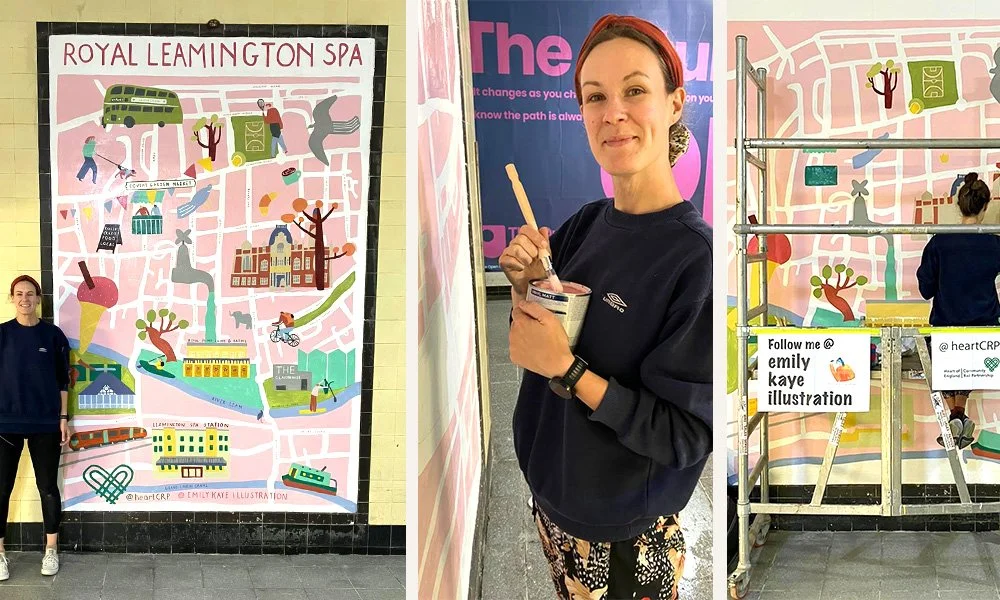
In 2021 I created a mural that lives opposite the stairs to platform 3 in Leamington Spa Train Station. It was the first mural I painted in my home town. I spent a week up scaffolding chatting to members of the public as they arrived from their journeys or made their commutes. At least once a month I receive messages or comments from local people telling me how much they love seeing the mural as they return home from a trip, how it reminds them they’re almost back home. Everytime someone tells me they like the artwork it reminds me of my mission to create more public art. Adding imagery to our shared spaces creates a sense of place and belonging, especially if we’re able to reflect some ideas or feelings that people can connect to. In this instance the mural is an illustrated map of Leamington Spa which felt like the perfect artwork to place in a centre for travel.
2) Improving how an area looks and how it’s perceived
One of the best examples I can think of for how public art improves an area is the incredible use of mural painting in underpasses. I know what you’re thinking…dark…dingy…poorly lit…unsavoury smells… But underpasses are those super functional routes that help us travel below busy roads safely. And lets not forget our foxy friends that are much safer travelling under the roads then over them.
Functional spaces like roads and alleys can feel just that - functional - which means the visual design is often an afterthought. If it offers a solid footpath and removes the risk of crossing a busy road then job done right!? But if they are dark, poorly lit places we’d rather avoid then we end up trying to cross the main road anyway. Public art can make these places feel cared for and intentional. Putting time and effort into a space radiates out and that effort, care and attention (along with good lighting please!) can have the knock on effect of improving foot traffic, making a space feel safe and allowing it to be the functional space it was designed for.
I can think of 2 great examples. When I lived in Bristol the central roundabout at the end of the M32 known locally as ‘The Bearpit’ thanks to it’s fearsome reputation, was just that…a network of dark tunnels that I’d rather avoid. With some initiative from passionate local councillors and the community this space became an experimental zone for the public. Over the years it’s been regenerated to have it’s own mascot, an open air theatre, fruit stall and an urban art gallery. There was even a converted bus selling ‘Bearittos’ at one point. Now more of an urban park the space seems to have evolved once more to return to being a public intersection but the efforts of the community to claim and use the area meant it became a safer, brighter and more hopeful place to walk.
My second example is this beautiful mural created by Al Stark. Even at night the yellow paint glows making this underpass look so welcoming. With paint we can tell people, yes…this is the right way to walk, you’re in the right place. How powerful is that?
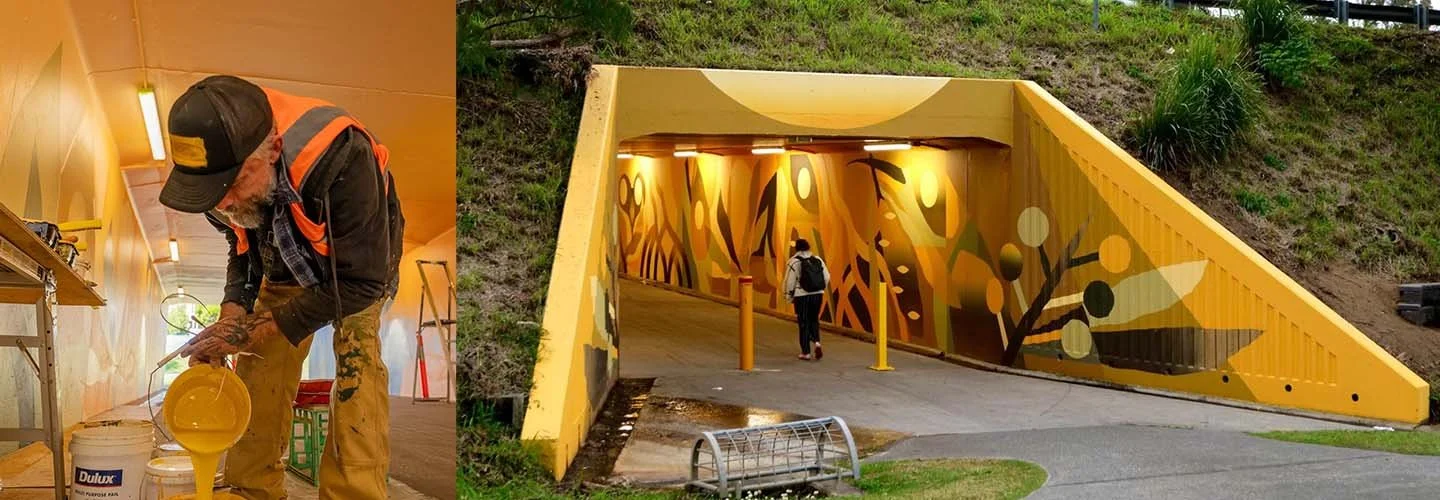
Art by Al Stark
3) Improving moods
Now its tricky to prove this one without going out and asking people on the street how is public art impacting your life? And no…it might not be a life altering shift…but there is a genuine uplift when we see the time and care that has been poured into a space. Multiply that by actually seeing something visually bright and joyful and you are on to a winner. I haven’t got a research paper to refer to here, and nor do I want to because sometimes facts and figures can’t quantify emotional impact…it’s like me saying ‘I’m telling you this fact so you have to believe me now so there’. Instead I have a personal anecdote.
I’m up a ladder, brush in one hand, tub of paint in the other…leaning against a pebble dash wall on a very hot sunny May day. It’s the last day of painting my mural on the corner of Tachbrook Street and I was distracted by the sound of a child crying behind me. (My baby was 10 months old at the time so the sound of any crying ripped right through me.) The little girl is walking with her patient Grandma, very slowly crossing the road bawling, tears streaming down her face. As they walked past the wall they paused…and in French I heard the woman describing my painting….’un poisson’….’un panier’….’des frites’ (the wall celebrated all the local businesses that have inhabited the row of shops over the past 100 years - including fish and chips!….and oui oui je parle un petit peu de Francais). And as she described, the little girl stopped crying. She started pointing out more pictures happy with herself for spotting shoes and a lemon. It was only a tiny moment but it made me think, if the painting wasn’t there, the perfectly timed distraction for a tired child would also be missing. Sometimes it’s not about beauty or hitting the perfect message with a piece of art, it’s a moment of escapism.
The other anecdotal evidence I can share is the number of messages I receive in response to my mural outside A&E at Worcester hospital. (I always tell people I hope they never see it or if they do it’s because they work there or are leaving on good terms). I love seeing messages drop into my inbox, people telling me how much the colour lifted their mood whilst they waited to be seen. One man left me a voice note telling me how much it left an impression on him. That’s all the evidence I need.
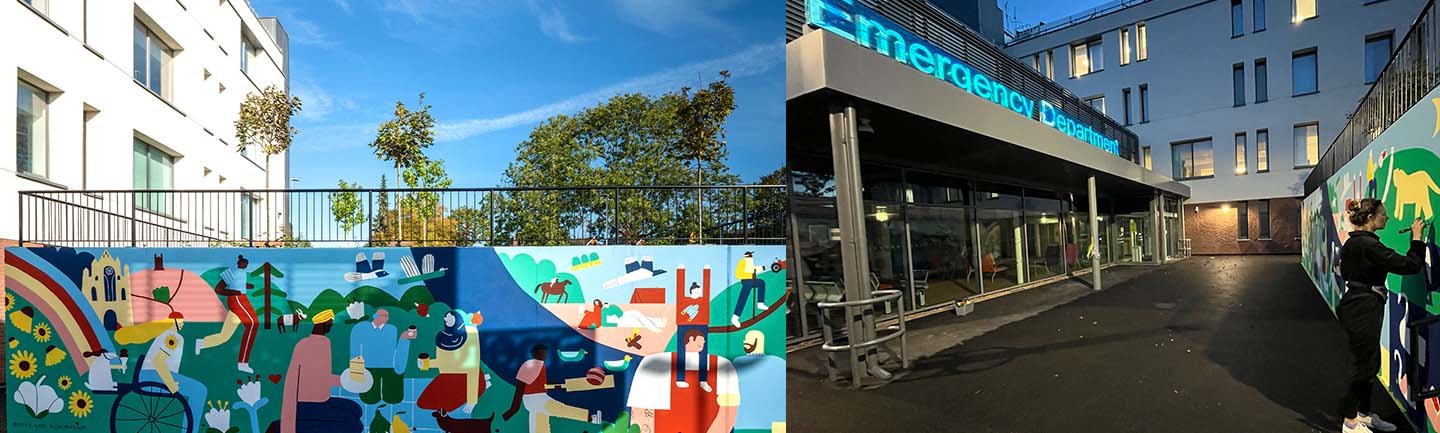
Painting a Mural at Worcester Hospital
Let me know what your thoughts are on public art. Do you see any in your local area? Do you agree with the points above? What spaces would you like to see given a little more attention?